Malibu City Council candidates face off on community’s most pressing issues
By Barbara Burke · Sun Sep 27 2026
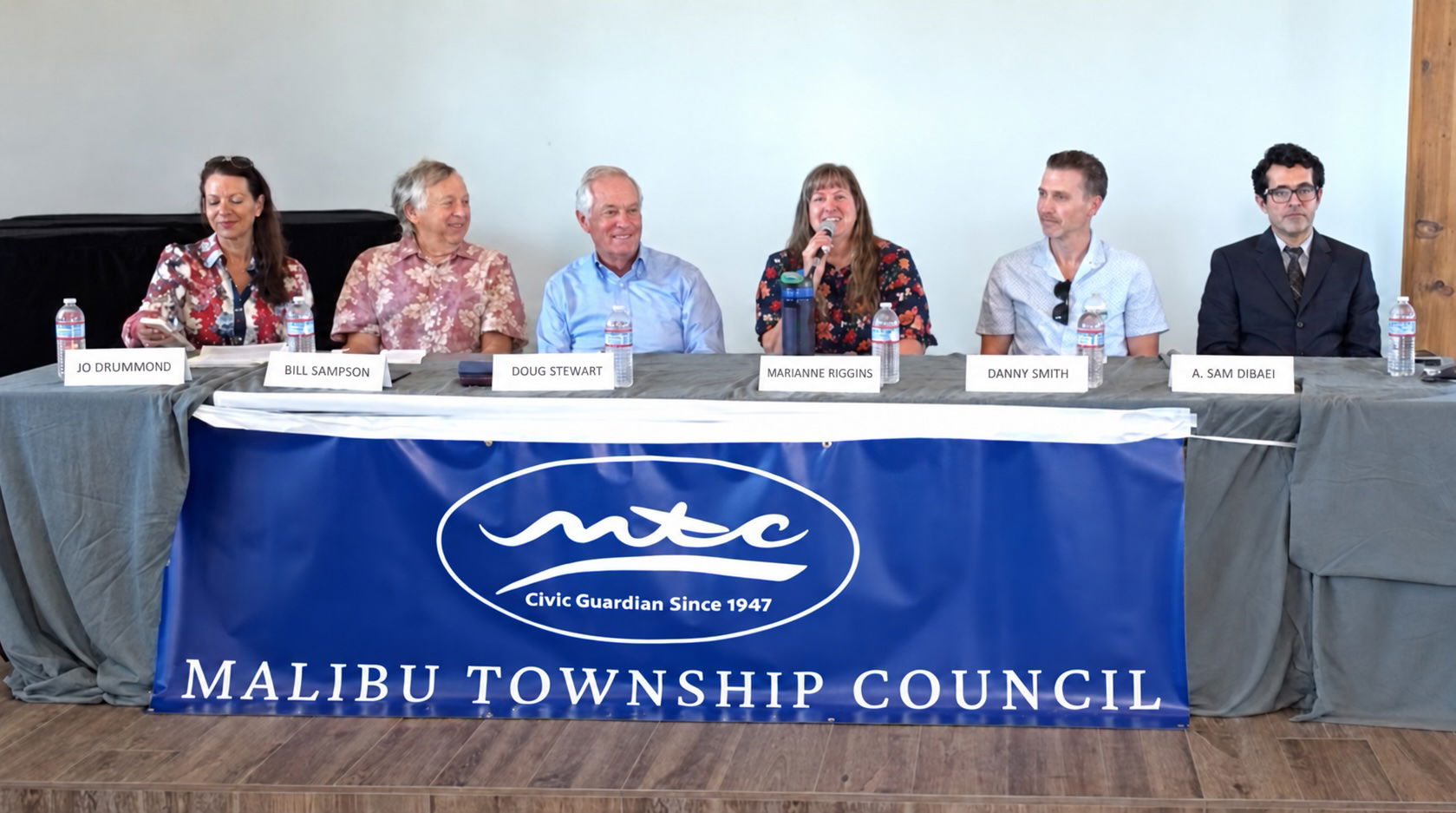
Incumbents and challengers debate wildfire preparedness, rebuilding, PCH safety, local businesses, and city finances at Malibu Township Council forum
Four candidates are vying for two City of Malibu council positions in the Nov. 3 election. The Malibu Township Council, Malibu’s oldest service organization that is approaching its 80th anniversary, hosted a candidate forum on Sept. 18, with all contenders present. Candidates include incumbents Marianne Riggins and Doug Stewart as well as newcomers Danny Smith and A. Sam Dibaei. Current MTC President Bill Sampson and former MTC President Jo Drummond moderated the discussion.
Meet the candidates
Stewart noted that he is endorsed by Los Angeles County Supervisor Lindsey P. Horvath, Los Angeles County Sheriff Robert Luna, the Association for Los Angeles Deputy Sheriffs, and the International Association of Firefighters Local 1014 union. “I have been a resident of Malibu for more than 26 years; I am proud to have been involved in the betterment of Malibu every day since then. During my tenure, the homeless population significantly reduced from 250 down to 50, which is not all my doing, but I’d like to take credit for my part in doing that.”
Riggins noted she is a Malibu native, has worked for the city for a number of years, and volunteered for Girl Scouts and various school organizations. “Creating and implementing our own school district here in Malibu was a main priority for me, and we have made strides to move that effort forward,” she stated.
Noting that he is “a husband, father, and wildfire survivor and serves as a zone captain for the La Costa Beach neighborhood in the rebuild effort,” Smith stated that he has been a critic of Malibu’s recovery efforts, noting the rebuilding “is behind the progress for rebuilding after the Woolsey Fire, which should scare everyone in the room.” He opined that Malibu’s small businesses are suffering, stating, “their outlook is bleak, our property values are in jeopardy, and homes are staying on the market longer than they are in nearby areas.” Smith qualified his comments by stating that he “did not point out these concerns to be a Cassandra, but rather to point out that our town is at a tipping point where we can choose to become stronger and more closely knit, or we can continue to unravel further.” Expressing that he has “great respect” for his opponents, he nevertheless opined that his opponents “don’t have what it takes to get Malibu through this crucial moment.”
For his part, candidate A. Sam Dibaei stated, “Friends, locals, Malibuites, lend me your ears. Fires, floods, water, safety, and education are the things that bring a community together, and these are the things that we are lacking.”
He asserted that having our city threatened by fires, by floods, and by a lack of basic safety will be his priorities should he be elected. Elaborating, he stated that until those issues are addressed, Malibu “cannot even get to addressing education.”
Eleven questions from MTC, starting with candidates’ priorities for Malibu
Drummond first asked the candidates how they “will improve Malibu. Dibaei responded that Malibu “needs to start moving forward and take proactive measures, not reactive measures.” He added, “We need to take prophylactic safeguards, not remedial safeguards. We need to take measures that will stop the fires, prevent the floods, and give us the community safety we all need.”
After accomplishing that, he stated that the town can address education, community development, and infrastructure. He noted that Malibu can “no longer apply band-aids to address imminent concerns, but must implement solutions.”
Smith, whose campaign slogan is “Renew the ‘Bu,” admonished that the City Council “can do a better job of initiating ideas and bringing forth programs for the staff to work on.” Smith prioritized getting Malibu’s residents back to town, increasing school enrollment, supporting small businesses, and getting the city’s revenue back on track. After that, he asserted, the town can then “think about the amenities such as how to develop and use community lands, potentially acquiring new lands to preserve and protect and then decide how we want Malibu to look in the future.”
“I’m all about listening,” Smith said in conclusion. “I have strong opinions on a lot of issues. I don’t know everything, and I would love to hear from the community on what’s important to them and what we can do better.”
Riggins spoke next, stating, “Working on having our own school district is incredibly important in encouraging more people to move here to begin with, not just to move back.” She also noted that she is passionate about addressing the community lands issue as, in her mind, “that’s important for our school enrollment,” as well as for the town’s permanent residents. She also informed that the council is working on increasing roadway safety, home hardening, and improvingwater infrastructure.
Stewart opined that “Malibu is two cities — one that burned and one that didn’t burn.” Further, in the rebuild area, there are part-timers and investors as well as long-term families who want to return to Malibu, he noted, adding that investors aim to sell some fire lots and experience a profit and often don’t intend to go through the permitting process to rebuild.Thus, he argued that the city should first focus on helping those who intend to rebuild and then focus on those who intend to sell. He noted that “in the rest of the town, residents are trying to get a school system in local control and the lands-project efforts to be accomplished.” He expressed that he hopes that in the fairly near future, Malibu can get soccer fields built on the Ioki Park.
Stewart, who has a banking and financial sector background, also focused on Malibu’s need to “replenish its budget and get ready for the next disaster — it’s one thing to say I’m going to improve Malibu, but we also have to protect Malibu,” he emphasized, especially because, “We’ve got a disaster potential coming up with El Niño that’s going to do damage all along our coast as well as flooding the interior.”
Candidates’ plans to ensure safe evacuations in disasters
When asked to address how to improve evacuation safety and efficiency during disasters, Smith stated he would “like to focus on working with Caltrans to keep four lanes of PCH open at all times. There is room on both sides of the highway to have four lanes striped.” He asserted that one side can be allocated for utility work, which, in his mind, should be doneat night, as that would improve evacuation efficiency and would also “keep businesses afloat and build a better quality of life for the residents.” In Smith’s mind, “Caltrans seems to work in a vacuum without city input, and they waste their time, because what they bring forward is unacceptable.” Accordingly, he said that Malibu’s elected officials “need to be in the room” when Caltrans’ decisions are made.
Riggins emphasized the city’s efforts to ensure that all residents are registered with the city to receive Everbridge notifications on their phones and via email. “Our highway is a crucial part of Malibu along with canyons, and we need to ensure that they stay passable and safe,” she stated. “Living in Malibu is an adventure, and you have to be ready. Everybody should have their go-bags ready!”
Stewart noted that he served as mayor during the Palisades Fire and was involved in the Woolsey Fire evacuations. He noted, “One of the first things you realize is there is no one way to communicate in a fire!” Elaborating, he admonished, “We have to be nimble and be able to talk to our residents!” Then, he stated that the city “is working with Alert FM, which works when everything else is out of service.”
Finally, Dibaei opined that “radio seems to be the most obvious way to ensure residents get emergency notices from the city and other authorities.”
Upholding Malibu’s vision and mission statements
Speaking first, Riggins emphasized the need for elected officials to “continue referring to our local coastal plan, our municipal and general plans and sticking to those guiding documents regarding how we approve anything.” She advocates granting variances on a very limited basis in unique circumstances, and “only when a development is proposed that conforms with the city’s documents, municipal code, general plan and mission plan.”
Stewart characterized the mission and vision statements, the local coastal plan, and Malibu’s business code as providing “the playbook” that mandates following a consistent building plan. “There is no reason to vary from that very much, if at all," he added. "We’ve got a playbook. Follow it! For the most part, there are not many reasons to provide a variance, unless it’s just a minor variance, as sometimes doing that is worthwhile.”
Dibaei answered the question by focusing on “prioritizing prophylactic methods in building, including constructing seawalls.” He only advocated variances to the city’s mission statement and design standards when they may be required on a case-by-case basis.
Smith emphasized he was drawn to Malibu due to its environmental-preservation focus and stated applicable standards “will be involved in every decision that I make as a councilmember — I would not know how to stray from them,” he added. “The reality of it is that we are constantly issuing variances — constantly! Every single appeal vote that the incumbents vote on has variances in them. If you want fewer variances, staff persons need to see policymakers who are interested in fewer variances on council.”
Ensuring Malibu retains its rural character
Next, candidates would ensure Malibu’s rural character. Stewart opined, “We do not need any more commercial development and to have more land chewed up” for such efforts. Rather, he asserted, “we should be repurposing the commercial properties we have.” Riggins agreed, stating, “We should definitely make sure that commercial buildings should be filled with the appropriate tenants for the community.”
Both Stewart and Smith advocate Code Enforcement being able to take the initiative to enforce the Dark Sky ordinance, rather than waiting for residents to complain. Dibaei observed that “although Malibu is rural, it is half burned and scarred and the time for being proactive and rebuilding Malibu is imperative.” He suggested that the city should also address filming without permits and filming above people’s homes.
With regard to the Dark Skies ordinance, Riggins is worried that the city needs to do more to educate people about the standards and what the lighting terms mean.
Addressing whether fire breaks are effective in 100-mph winds and addressing fire preparation measures
Dibaei advocates home hardening and establishing fire breaks, and he added, “There have been cities on the water since the beginning of time, and we can take steps to provide water to fight fires such as building a sequence of pumps whereby water pumps from the ocean into where creeks flow above the ocean.” Elaborating, he said, “If we had such a pumping system at Kanan it could have helped in the Woolsey Fire, and if there were water pumps where the coastal lots burned, many of those homes could have been saved in the Palisades Fire.”
Smith advocated expediting home hardening measures and also stated, “We need water — cisterns should be placed on all community lands that can bear them geologically.” He also said, “Disasters will come, and how we organize ourselves to prepare for them will help determine how we handle them. I love the Community Brigade, and we need to support them and also participate in home hardening.”
Riggins notes that she “strongly advocates improving home hardening, supporting fire breaks and working with residents in the Santa Monica Mountains where many fires begin” and reducing fuel loads and possibly employing controlled burns. “We need as much water as we can get, including people having water tanks and having sprinklers,” she added.
Stewart quoted Chief Anthony Maroney of the Los Angeles County Fire Department, who said that “there are not enough fire trucks to fight all fires.” Accordingly, the city is “putting defensive fire breaks and measures in the Santa Monica Mountains, with goats, controlled burns, fire hardening, and land planning,” he said. “We got state money from Proposition 4, and we need to keep fire prevention efforts continuing.”
Supporting small local-serving businesses
“I need my Ralphs and my UPS,” Smith exclaimed. “To help small businesses, I want to lobby the state for a sales tax holiday.” He also suggested that the city should provide trash cans along PCH, as doing so “would help small businesses maintain rights of way and cleanliness.”
Riggins stated, “I think reminding everyone to go to the different restaurants and encouraging people to shop local is very important! We want to make sure people are aware of small businesses that are community-serving,” she added. “Further, partnering with the local schools and businesses can help get people to go into our businesses, and we need to continue to work on ensuring we have businesses here that people want. When we work with the PaliBu Chamber of Commerce, we need to emphasize that we need shops for everyday residents.”
Responding, Stewart soberly noted that in our country, “Online sales are now exceeding on-site sales.” That reality hits small local businesses hard, he noted. “On the upside, measures that Malibu is taking are helping struggling businesses," he said. "We don’t have business licenses for most businesses in Malibu, and we have expedited tenant improvement permits.” In his mind, the struggles that local businesses face concern rental and labor costs. “If the first 10 days of the month are spent trying to pay your landlord, it’s not tenable,” he said. “The real problem is the rents and the minimum wage — we have to creatively find a way to cut costs down.”
Dibaei stated, “I would respond to what the residents want us to do — there are very few local businesses owned by locals in Malibu. Why not encourage locals owning local small businesses? Those with whom I have spoken are asking for rent stabilization, and if we address that request, we can get more local businesses.”
Short-term rentals and rehabilitation facilities
“We need a permitting program for short-term rentals and to ensure we don’t have too much saturation of them in neighborhoods,” Riggins said. “Short-term rentals do have a place in Malibu — many of our residents used them after the fires.”
However, she noted that concerns relating to having a great amount of rehabilitation facilities in Malibu “present a tricky problem as the state mandates the laws and there is very little the city can do so we need to inform state officials about the problems they present.”
Stewart informed that there are approximately 800 short-term rentals in Malibu and 73 were burned in the fire. “If you are making your apartment or building a permanent hotel, that is not okay,” he opined. “So, we need to limit the number of nights you can rent a short-term rental. As for rehabilitation facilities, it is tough for us to eliminate them as they are state-controlled. However, we can make them compliant with our laws through code enforcement.”
“Life. Liberty. Property. Those are the rights of all citizens,” Dibaei emphasized. “I don’t think we need to change the septic tank standards applicable to AirBnb’s.” Expressing a strong point of view, he stated, “As it relates to people renting their homes for the summer, they should be able to do so. I don’t think the government should tell people what they can do with their homes.”
Smith concurred with Riggins, suggesting a lottery system for short-term rentals. “In my mind, development diminishes desires,” he said. “I have seen nothing in the state law that would prohibit a residential-sized septic system to limit development.”
Should Pacific Coast Highway be a boulevard and if so, what speed limit should apply?
Stewart noted that the issues faced by Malibu concerning configuration of the Pacific Coast Highway are strongly affected by the state-imposed constraints for such things as bicycle lanes and sidewalks. “We need to reduce speeds,” he stated. “I advocate that speed limits be reduced, and we also need to build narrow lanes, which will also reduce speeds.”
Dibaei advocates keeping PCH as a highway. “Speed limits that go from 50 to 45 to 30 are not tenable,” he said. “I would put toll roads on both ends, and locals would get in free — that is something that we need to address, with an eye toward ensuring safety. I don’t think that the Flock cameras will deter.”
Smith advocates a 35-mile speed limit and said, “I support any traffic calming measures that Caltrans proposes provided they collaborate with the city. We need more crosswalks — if they are lighted, it will slow people down in appropriate spots.”
Riggins noted that PCH is 21 miles long and therefore, different segments of the highway should be handled differently.“Between the eastern city limits and John Tyler, we should have a 35-mile speed limit,” she proposed. “With state-law-mandated bike lanes and pedestrian paths, we need to make sure the roadway complies with laws and is safe.”
Solutions for ocean intrusion onto PCH lots
“We can’t control the speeds; we cannot control the highway,” Dibaei proposed. “Caltrans should carry the responsibility for repairing the highway. That should not be the responsibility of the homeowners, and we should enforce Caltrans’ duty to do that with litigation if necessary.”
Conversely, Smith praised Caltrans’ efforts to install boulders on lots susceptible to damage due to coastal erosion and complimented Caltrans’ recent agreement to remove the boulders when affected homeowners are ready to build. Smith noted that he advocates immediately establishing a Coastal Erosion Committee to address the impending rains and thethreats to the coastline. “Westward Beach, the sinkhole, eastern areas being affected by coastal intrusion all mean that we need to get a lot of people together to address the issues,” he said.
Riggins focused on “the property owners first deciding if they will rebuild.” She added, “ I agree that the homeowners should not bear the cost of protecting the highway — the state and even the federal government should come in and protect the highway.” She noted that some communities, such as Santa Monica, have wider beaches than Malibu and wondered whether Malibu could replicate any beach-saving measures.
Stewart noted that “the city is being proactive and putting together an erosion control flood management plan that resembles efforts to prepare for a natural disaster such as a fire.” He added that,“thanks to the city’s efforts, the state realizes it has to protect its highway since the houses that burned are no longer there.” He praised the city for convincing the state that those rebuilding should be able to rebuild destroyed structures like-for-like to the homes that the owners had before the disaster.
Addressing vehicular noise and speeds
Smith noted that City Manager Joe Irvin provided feedback regarding cars with modified exhaust systems caravanning in the Las Flores neighborhood late at night. “The city’s ability to add speed bumps and take other speed enforcement efforts is somewhat limited,” he stated. He suggested that “the city employ sound meters which the Laguna Beach police department uses to enforce noise ordinances and to apprehend those who have modified their exhausts and mufflers.” He noted that he would also consider following a recommendation from a constituent who proposed classifying any three or more vehicles with similar stylings or modifications as a parade and enforce applicable parade regulations.
Riggins emphasized that enforcement is pivotal. Thus, she advocates having more law enforcement on the ground. “We got the California Highway Patrol on the PCH, and that has helped with additional enforcement,” she said. “Further, we have entered a parking enforcement contract so the sheriffs can focus on the highway.” She noted that if the “sheriff works with social media experts so they can find out how such vehicle racing events are organized, law enforcement could organize sting operations.”
Stewart opined that the city only has two or three patrol cars for the entire PCH. He lamented that, as to Las Flores’ concerns, that roadway doesn’t qualify for speed bumps. He noted that Laguna is different as it has its own police force and the Sheriff’s Department will not enforce speed monitoring in Malibu.
Dibaei said, “The state should be proactive about enforcing its laws.” He also noted that sound walls might be warranted in some areas as they are in other communities. “We need to tailor the solutions to the problems,” he said.
Maintaining an appropriate fiscal reserve and protecting the city’s bond rating
Riggins focused on the city’s need to ensure it has reserves on hand for disasters. She stated, “This year, we did some belt-tightening to ensure we still meet our goals to keep a reserve of 65 percent of our general fund.”
Stewart informed that he “put $4 million a year into the general fund by taking money we had in the reserve account and putting the funds into safe bonds, certificates of deposit, and short-term money markets. Before, it was in a checking account in the amount of almost $100 million.”
That said, he noted, the city has large financial obligations. “We are looking at a sewer bond of almost $130 million and other obligations that are very expensive,” he noted, adding, “We’re talking about a 200% increase in the city’s debt load. We have to make sure that we keep the best bond rating so we can have the lowest interest rate on that debt. At present, we have just enough for one more disaster. We have a five-year plan in place to ensure we retain our good financial rating by belt-tightening.”
Dibaei stated that the city “needs a treasurer or an independent accountant,” and that in his mind, “That is the first step. The auditor who audited the city’s finances found that there are no internal controls. I don’t think the people of Malibu know that the city doesn’t have a treasurer!”
Smith addressed that assertion by noting that the city has a contracted treasurer. Then he emphasized, “We have to rebuild as soon as possible for the property tax and sales revenues, and that would also increase the short-term rental revenue.” He emphatically stated, “I would drop the rebuild center lease like a bad habit! Entering into that transaction was a mistake, and the city could have hired three full-time engineers for the cost of the lease, which expires in the spring.” Smith added, “I would also be in favor of listening to Joe Irvin, who has an idea for installing parking meters in select locations as that could provide a good revenue source.”
A myriad of audience questions
The incumbent candidates were asked whether they would keep their appointed planning commissioners. Riggins’ appointee is Skylar Peak, while Stewart’s appointee is Drew Leonard. The moderator noted that many view those planning commissioners as having an ironclad pro-development stance.
“My planning commissioner is a former City Councilmember, and when I appointed him, he was, as I understand it, viewed as a preservationist. So, that he is viewed differently seems a little unusual to me," Riggins said. “I don’t have any plans to replace him as I’m happy with the decisions he has made and he has Malibu’s best interests at heart.”
Stewart noted that the planning commissioner position “is a semi-judicial position and we have only a few appeals from the commission, which is good.”
The other two candidates — Smith and Dibaei — were asked whom they would appoint as planning commissioners.
“I would appoint someone who complies with what the people want, as that is what I think a councilperson should do,” Dibaei responded.
Smith noted that he did not have a specific person to appoint in mind, but would consult with his trusted advisors who are long-term Malibu residents. “I do think that currently, there is an imbalance on the commission which is leading to a lot of appeals as well as discontent within the city, and I would do my part to change that,” he stated.
A final question asked the incumbents, “Why should voters vote to keep you in office when there have only been 100 permits issued after the Palisades Fire and half the properties that burned in the Woolsey Fire remain unoccupied?”
Responding, Stewart noted that a recent study found that of the 530 homes that burned in the fire, along the beach, 270 of them were not owner-occupied. Rather, they were secondary or investor-owned homes. “My goal is to help get the people who were residents back in their homes, amounting to 250 homeowners or so,” Stewart said. “Then, we have to figure out what to do with the investor properties.”
Riggins said that the city “is trying to turn over permit applications as fast as possible, but unfortunately, to build a house in Malibu takes time and there is a lot of work that the homeowner has to do and some of them are overwhelmed with that.”
To address that problem, she suggested, “Maybe we should explore perhaps having more uniform housing or prefabricated housing where people can choose out of a catalog what structure should be placed on their foundation — we should have that community discussion.”
The challengers were asked why people should vote for them, with an emphasis on the fact that neither of them has served on a city commission.
Smith noted he applied for a commission position, but he was not selected. He asserted he was a good candidate to address the fact that, “The city is not meeting its own timelines and its consultants are not meeting timelines.” He continued, “Yes, it’s hard and expensive to rebuild in Malibu, but I would ask for a list of everybody who is in plan check on a Monday and then go back two weeks later — which is after 10 business days — and ask who is still in plan check and why they are stuck there — that kind of public pressure will immediately see results.” In Smith’s mind, Malibu needs to implement electronic plan reviews. He pointed out that both Stewart and Riggins voted against them.
Dibaei noted that he has not applied to serve as a commissioner, but instead is focusing on the council position and, in his mind, “We don’t need prefabricated or tract homes as those do not comply with Malibu’s rural character. Rather, we need to move people back in whether they are residents or not — if they own the property, they should be able to rebuild the property.”
Finally, the candidates were asked how and when they would increase police presence in Malibu. Dibaei observed that Malibu does not have a high murder rate or many violent crimes. Thus, he advocates providing more police to address specific problems such as burglaries and traffic crimes.
Smith stated he would explore ways to staff Malibu’s sheriff’s substation and opined that the council “should explore Malibu having its own police department as we spend $13 million on contract services with the Sheriff’s Department.”
Riggins lamented the paucity of applications to serve as deputy sheriffs and noted that for now, the volunteers on patrol are helping, providing part of the solution, and that thankfully, Malibu now has California Highway Patrol on the highway. Stewart noted that he spearheaded the effort to contract with the CHP, but noted that currently, Malibu is only served by three officers.
One citizen asked why Dibaei had been disbarred by the State Bar of California and why voters would trust him with their money. He responded, stating, “I represented four clients, never took any money from them, and I got them $385,000. That same case was also litigated in actual court, Superior Court Case LC10357, and that tribunal found that I had stolen no money, and the former client and the state bar judge, which is not a constitutional entity, were, let’s say, uh, family friends. So, in fact, I never had taken anyone's money ... Where are the receipts? Where is the proof? Because that would be a crime. It is very easy to shame me online saying I have poor moral turpitude, but the laws of the state are clear — I have committed no crime.” He noted that he has never attempted to reinstate his bar license.
Finally, when the incumbents were asked why the residents should vote for them, they noted their achievements, with Riggins stating that her efforts assisted in furthering Malibu’s efforts to get its own school district. She stated that her efforts regarding community lands helped to establish the new skate park, and she asserted she was instrumental in the city now having plans for the Ioki, Heathercliff, and Triangle lots and hopefully for the La Paz plot. Riggins stated, “I think I've been successful in helping with fire rebuilds and have always done my best and had Malibu’s interests at heart.”
Stewart emphasized that he has helped Malibu be more fiscally fit and that the city’s workplace has improved for its employees. “I think that the fact that we got a city manager of the caliber of Joe Irvin speaks a lot for Malibu,” he said. Although both incumbents noted that Malibu faces challenges, they advocated for the voters to let them stay on the council and further guide those processes.
Dibaei advocated for himself by stating, “How much worse could I possibly be? The city has burned to the ground. I am here for fire, for water, for safety, and for education.” Continuing, he stated, “Ask yourselves: in the past four years have those things improved or not? Has there been a catastrophic fire recently that would have lent itself to us thinking maybe there’ll be another one? Or is El Niño, the southern oscillation that happens every 13 years, an unpredictable event?”
Finally, Smith stated, “I think my incumbent opponents like their jobs too much — I think their egos are tied up in them. I have a friend who’s fond of saying, 'Beware of a politician who really wants their job.' I don’t really want this job — I see it as a calling because I think I can help.”
Future candidate information efforts
Future town hall candidate forums are scheduled. On Oct. 10, the Eastern Malibu Candidate Forum will be held from 10 a.m. to noon at the Malibu Library, 23519 West Civic Center Way in Malibu.
RSVP to: BRMPOAPREZ@gmail.com.