Residents rally against antenna tower at SMC Campus
By Hayley Mattson · Sat Sep 27 2025
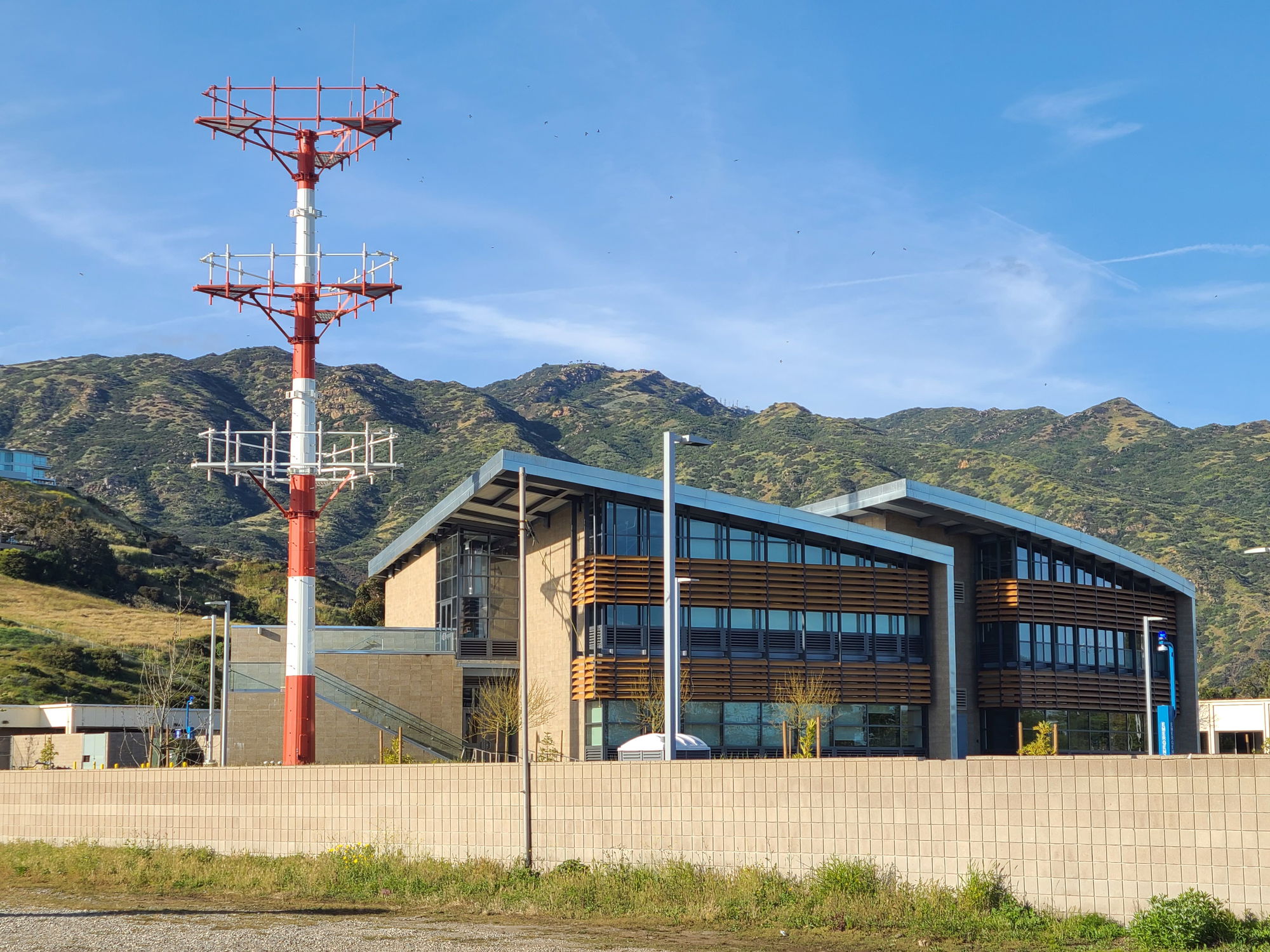
City Council to Address Community Concerns Over Health Risks and Zoning Violations at September 29 Meeting
The contentious issue of the communications tower at Santa Monica College’s (SMC) Malibu Campus, located at 23555 Civic Center Way, is expected to be discussed at the Malibu City Council’s next meeting on Sept. 29. The towering structure, often referred to as the “county antenna pole,” has sparked ongoing debates since its construction in 2022, with residents decrying its non-compliance with city zoning codes, its visual impact, and potential health risks. As the city wrestles with retroactively bringing the tower into compliance, Malibu residents are mobilizing to demand transparency, accountability, and action from their elected officials.
The communications tower, erected as part of the SMC Malibu Campus development alongside the Los Angeles County Sheriff’s Substation, was intended to bolster public safety communications. However, its construction on county-owned land within Malibu’s city limits has created a jurisdictional problem. The tower, which supports critical radio communications for the Sheriff’s Substation, was built without proper city permits, violating Malibu’s stringent zoning and aesthetic regulations. Standing between 86 and 91 feet tall — exceeding its approved height of 75 feet — the structure has been labeled an “eyesore” by residents, visible from Legacy Park and Pacific Coast Highway against the scenic backdrop of the Santa Monica Mountains.
Community opposition has been aggressive. Residents argue that the unpainted, unlandscaped tower not only detracts from Malibu’s natural beauty but also poses potential health risks due to electromagnetic field (EMF) emissions. Critics, including the Malibu Township Council (MTC), assert that the tower’s emissions could reach levels 5,000% above what is considered safe, particularly concerning given its proximity to classrooms at the SMC campus, where classes began in January 2023. Furthermore, the tower’s additional function as a microwave relay to the South Bay — a use not disclosed in earlier reviews — has fueled accusations of inadequate transparency during the project’s approval process.
At a June 2024 Malibu Planning Commission hearing, residents and officials voiced their frustrations. Former Planning Commissioner Kraig Hill questioned whether the tower could be made less invasive while maintaining its safety functions, asking, “Can we keep it just as safe and do it in a less invasive way?” Meanwhile, John Mazza, speaking on behalf of the MTC, condemned the tower’s construction, noting that the applicant had violated the approved 75-foot height limit by adding fill material around a raised foundation. “The pole should be painted a beige color that matches the college, and all lights must be removed as the FAA does not require them,” Mazza stated, adding that existing, lower-profile communications towers already serve the same purpose.
Resident Ryan Embree echoed these sentiments, highlighting a pattern of procedural oversights. In a June 2024 statement, Embree expressed dismay that his earlier correspondence, including a May 2023 email calling for a revocation hearing, was allegedly omitted from the city’s records. “How could it possibly be that the City staff excluded my correspondence on this illegal pole when I have addressed the City about it several times?” he asked, implying a lack of accountability in the permitting process.
Proponents of the tower, primarily county officials, argue that it is essential for the Sheriff’s Substation’s radio communications, a critical component of emergency response in wildfire-prone Malibu. However, critics counter that existing infrastructure, such as the Saddle Peak communications site, already supports sheriff, fire, and emergency services. They argue that the tower’s additional EMF emissions would exacerbate already high levels in the Civic Center area, posing unnecessary risks to students and residents.
Moreover, the Sheriff’s Substation itself remains unopened due to staffing shortages, a point raised by Councilmember Doug Stewart in a prior interview last year. “The county has said we cannot open the substation until all outstanding issues are cleared up,” Stewart noted. Critics argue that the lack of immediate need for the substation undermines the urgency of approving a non-compliant tower, especially given the potential health risks to SMC students and nearby residents.
The tower’s history is rooted in the SMC Malibu Campus project, which broke ground in September 2018 but faced delays due to the Woolsey Fire and the COVID-19 pandemic. Despite these challenges, the campus opened in 2023, hosting classes and community organizations. However, the tower’s construction without proper permits has fueled distrust between Malibu residents and external entities like Los Angeles County and SMC. This tension is compounded by broader disputes, such as those over Southern California Edison’s Public Safety Power Shutoffs, which have similarly pitted local priorities against regional mandates.
As the Sept. 29 City Council meeting approaches, residents are urged to make their voices heard. The meeting, held in a hybrid format at City Hall and via Zoom, offers opportunities for in-person and virtual participation. Comments can be submitted to citycouncil@malibucity.org, and the latest agenda packet is available at malibucity.org/AgendaCenter.
Community advocates are unequivocal in their demands: relocate the tower behind the campus, lower its height, and conduct a proper environmental review to assess EMF risks. They also call for greater transparency, pointing to the 2016 SMC Coastal Development Permit staff report that “buried” the tower’s true purpose and scale. “This isn’t about aesthetics,” one resident stated. “It’s about protecting students, families, and residents from preventable harm.”
The Malibu City Council holds the authority to enforce compliance or demand the tower’s removal, but jurisdictional complexities with Los Angeles County complicate the process. City staff have proposed retrofits like camouflage, vegetative screening, or height reduction, but these measures have yet to satisfy community concerns. The MTC has called for outright denial of the county’s after-the-fact permit application, arguing that alternative solutions exist without compromising public safety.
Read full agenda and how to participate in Monday's meeting here.