Mistrial declared in federal Palisades Fire arson trial; prosecutors plan retrial
By The Malibu Times · Sat Jun 27 2026
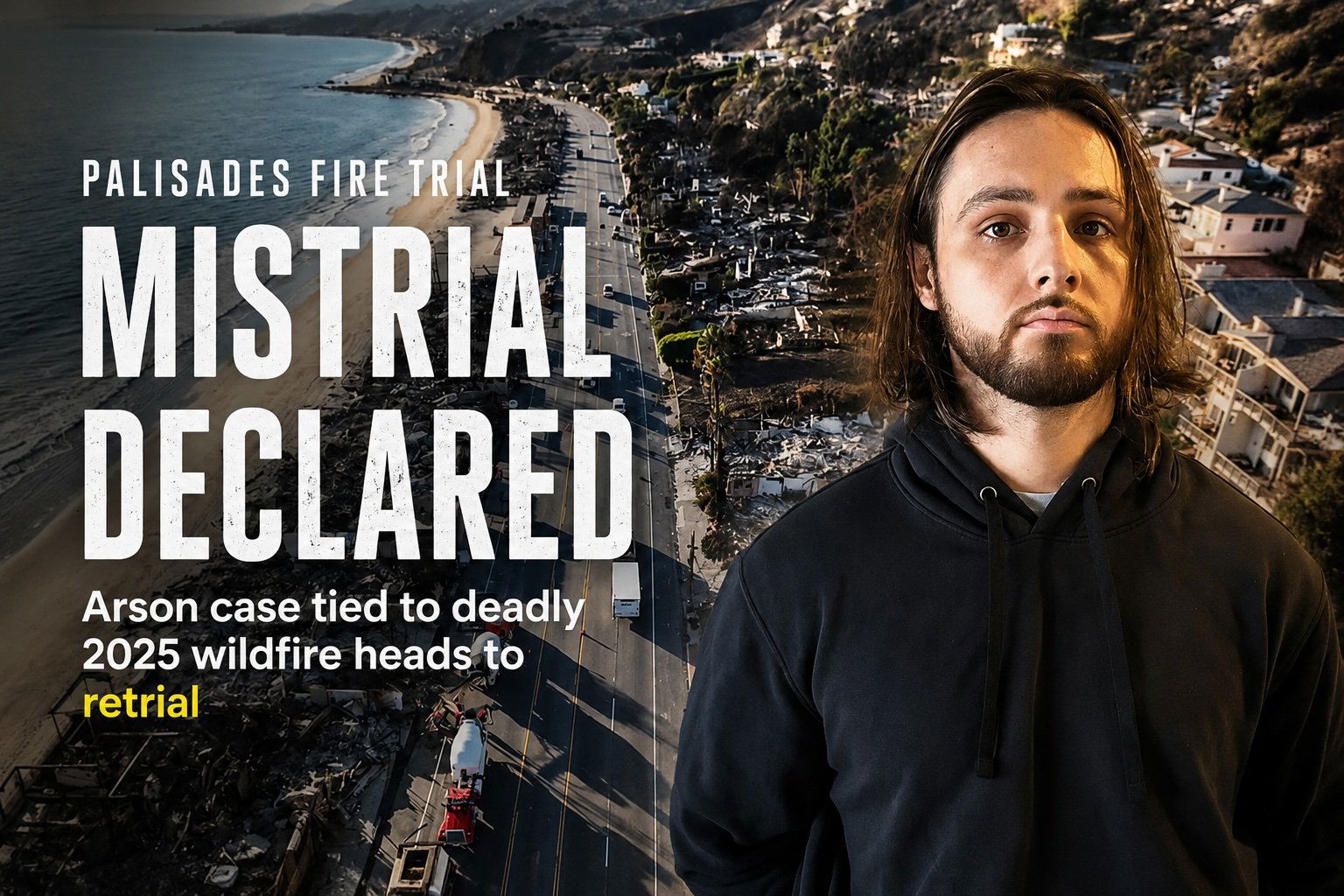
A federal judge declared a mistrial Friday, June 26, after jurors were unable to reach a unanimous verdict in the closely watched arson trial of Jonathan Rinderknecht, the man accused of igniting the January 2025 fire that prosecutors say ultimately grew into the devastating Palisades Fire.
After approximately 13 hours of deliberations over two days, the 12-member jury informed U.S. District Judge Anne Hwang that it was hopelessly deadlocked. According to the jury foreperson, 10 jurors favored acquittal while two voted to convict on all three federal charges. Judge Hwang ruled that continuing deliberations risked coercing jurors and declared a mistrial.
A retrial has been tentatively scheduled for Oct. 19, with a status conference set for July 15. Rinderknecht will remain in federal custody pending the new trial.
The 30-year-old former Uber driver and dual U.S.-French citizen was charged with destruction of property by means of fire, arson affecting property used in interstate commerce, and setting timber afire. If convicted on all counts, he could face up to 45 years in federal prison.
Federal prosecutors alleged that Rinderknecht intentionally started a brush fire, known as the Lachman Fire, on Jan. 1, 2025, using an open flame. Investigators contend the fire smoldered underground in root systems for nearly a week before high winds on Jan. 7 reignited it into what became the Palisades Fire.
The resulting wildfire killed 12 people, destroyed more than 6,000 structures across Pacific Palisades and Malibu, scorched thousands of acres, and displaced thousands of residents. It remains one of the most destructive wildfires in Los Angeles history.
During the two-and-a-half-week trial, prosecutors relied heavily on circumstantial evidence, including cellphone geolocation data, surveillance footage, 911 calls, and digital records that placed Rinderknecht near the fire's origin around the time it began. They also introduced evidence from his online activity, including internet searches and conversations with ChatGPT discussing responsibility for fires and expressing anger over wealth inequality, arguing the evidence demonstrated resentment toward affluent communities and a motive rooted in "societal revenge."
The prosecution also pointed to statements Rinderknecht made during an interview with investigators that they characterized as inconsistent, along with expert testimony regarding arsonist behavior.
Defense attorney Steve Haney countered that the government's case lacked any direct evidence linking his client to the ignition of the fire. The defense argued that New Year's Eve fireworks were a far more likely cause, citing witnesses who reported hearing fireworks and seeing teenagers fleeing the area. Haney also challenged the integrity of the investigation, arguing the scene was not properly secured for nearly two weeks and that investigators developed tunnel vision early in the case.
Following the mistrial, Assistant U.S. Attorney Bill Essayli said federal prosecutors intend to pursue the case again.
"The evidence is strong that Jonathan Rinderknecht is responsible for igniting the fire on January 1, 2025, which eventually became the Palisades Fire," Essayli said. "We fully intend to retry this case before a new jury and obtain guilty verdicts on all charged counts."
Haney described the jury split as a significant victory for the defense.
"Ten to two is a pretty resounding indication of what the jury felt about this case," Haney said, adding that he believes a second trial will result in an acquittal and calling for prosecutors to dismiss the charges altogether.
After the verdict, one juror, who identified herself only as Syrena, told reporters she voted not guilty because she believed prosecutors failed to prove Rinderknecht started the initial fire beyond a reasonable doubt. She also questioned whether one individual should bear responsibility for the catastrophic wildfire that followed, suggesting additional factors, including the response after the initial blaze, contributed to the disaster.
Although the criminal case remains unresolved, the mistrial leaves unanswered one of the most significant legal questions arising from Southern California's deadliest wildfire disaster in recent history. Prosecutors now face the challenge of presenting their case to a second jury later this year, while thousands of fire victims continue rebuilding their homes and lives in Malibu and Pacific Palisades.
The Malibu Times reported on Thursday, June 25:
Closing arguments heard in Palisades Fire suspect’s trial
By Judy Abel
The federal arson trial of Palisades Fire suspect Jonathan Rinderknecht is wrapping up in a Los Angeles courtroom asjurors were scheduled to hear closing arguments this past Tuesday, June 23. The trial, which began earlier this month, centers on one of the most closely watched wildfire-related criminal cases in California history.
Rinderknecht, 30, a former Uber driver, is charged with federal arson offenses stemming from the Jan. 1, 2025, Lachman Fire in the Pacific Palisades. Prosecutors allege that Rinderknecht maliciously set the blaze that then smoldered underground for several days before re-emerging as the catastrophic Palisades Fire. That fire, which killed 12 people and destroyed thousands of homes, including more than 700 in Malibu, became one of the most destructive and costliest wildfires in Los Angeles history. Rinderknecht has pleaded not guilty to all charges.
The trial has featured sharply contrasting narratives from the prosecution and defense. Federal prosecutors have argued that Rinderknecht intentionally set the initial fire and that geotracking evidence presented during the trial established both his presence at the scene and his responsibility for igniting the blaze.
According to prosecutors, security camera footage, cellphone records, witness testimony, and investigative findings collectively place Rinderknecht at the point of origin of the fire shortly after midnight on New Year’s Day. Government attorneys have also highlighted digital evidence and online communications that they contend reveal anger, frustration, and an unusual fascination with fire in the months leading up to the incident.
During opening statements, Assistant U.S. Attorney Matthew O’Brien characterized Rinderknecht as a man seeking “revenge against society” following personal setbacks, including the end of a romantic relationship. Prosecutors also introduced evidence related to online conversations and prompts found during the investigation, arguing that they provided insight into the defendant’s state of mind before the fire began.
The defense, however, has consistently maintained that the government’s case is built on speculation rather than proof. Defense attorney Steve Haney has argued throughout the proceedings that prosecutors failed to produce direct evidence showing that Rinderknecht deliberately started the fire.
Haney has emphasized that his client repeatedly contacted emergency dispatchers to report the blaze and cooperated extensively with investigators after the incident. According to the defense, those actions are inconsistent with the behavior of someone attempting to conceal a crime.
A major focus of the defense case has been the possibility that fireworks ignited the initial blaze. Several witnesses testified about hearing or observing fireworks in the area around the time the fire began. The issue gained additional attention during the trial when firefighters offered conflicting accounts regarding whether fireworks were present in the vicinity shortly before the fire was reported.
One firefighter testified that he observed flashes and heard fireworks near midnight, while another member of the same response team said he neither saw nor heard fireworks. The conflicting testimony became a focal point for defense attorneys seeking to establish reasonable doubt about the cause of the fire.
The trial also included extensive testimony from federal investigators with the Bureau of Alcohol, Tobacco, Firearms andExplosives, who described the methods used to determine the fire’s origin and trace Rinderknecht’s movements on the night in question. Prosecutors argued that no credible evidence supported alternative explanations for the fire and maintained that the physical and digital evidence pointed to only one conclusion.
Judge Anne Hwang made several significant evidentiary rulings during the proceedings, including limiting efforts by the defense to argue that firefighting agencies were negligent in their response to the initial blaze. The court determined that questions regarding suppression efforts were not directly relevant to whether Rinderknecht intentionally ignited the fire.
Critics of the prosecution have argued that Rinderknecht is being used as a scapegoat due to a lack of resources in Los Angeles while also blaming the actions of LA Mayor Karen Bass, an empty reservoir, a delayed response, and a natural disaster as a cause of the widespread devastation.
Los Angeles City Councilmember Traci Park has been closely watching the trial. She stated, "There's no way around the fact that on Jan. 7, every system that we needed failed. From our public safety systems to even having water for our firefighters.”
Following closing arguments and final jury instructions, deliberations are expected to begin as jurors weigh competing explanations for the fire that altered large portions of Los Angeles County, scattered residents, and left lasting scars on communities still struggling to rebuild.