Los Angeles County after-action report identifies missteps in Palisades Fire
By Judy Abel · Sun Sep 27 2026
Some recommendations identified after Woolsey never implemented
Los Angeles County’s latest independent review of the Palisades and Eaton fire recovery has concluded that authorities often relied on improvisation while helping communities and most importantly never implemented solutions identified in after-action reports from the Woolsey Fire in 2018. The McChrystal Group’s 185-page review, “County’s Palisades Fire Recovery,” released Sept. 11, found that many of thesystems needed to help communities recover were either outdated, incomplete, or nonexistent when the fires struck.
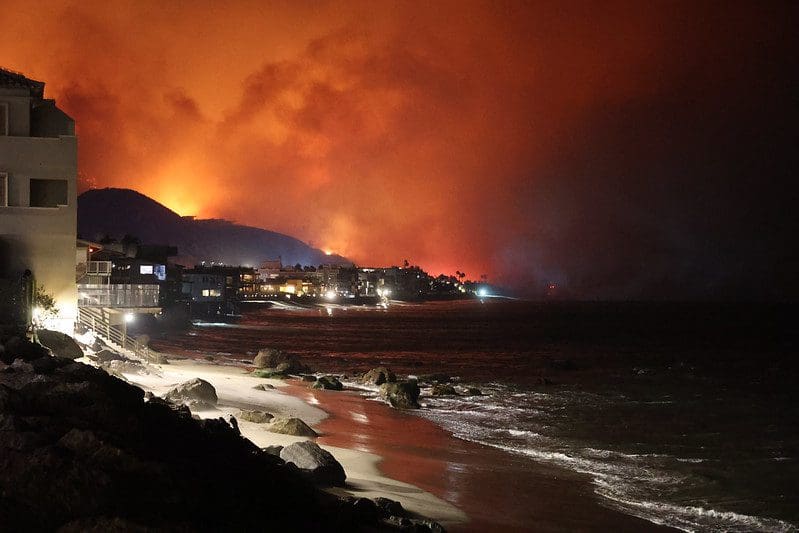
The Palisades Fire burned into Malibu, destroyed homes and businesses, and left residents dealing with evacuation, restricted access, debris removal, environmental concerns, and prolonged displacement.
The report examined the first three months following the Jan. 7, 2025, fires. It identified 26 substantive findings and 25 recommendations. The review stressed that it was not an investigation designed to assign blame, but rather an examination of the county’s systems and processes.
Its overarching finding was that county employees often succeeded through personal experience, relationships, and improvisation rather than through established plans. The county lacked an updated Operational Area Recovery Plan, a formal framework for deciding when communities could be repopulated, a countywide volunteer and donations system, and integrated information for reaching vulnerable residents.
One of the most consequential findings for Malibu residents involved who had the authority to make repopulation decisions. The review found that decision-making authority was not clearly understood among county agencies. The roles of the Office of Emergency Management and Department of Public Health in re-entry decisions were not sufficiently defined, while Public Health lacked a formal wildfire-specific role matrix or decision-support protocol.
That finding echoes a recommendation made after the Woolsey Fire. The 2019 Woolsey after-action review contained 85 recommendations. McChrystal found that only 30 had been implemented before the January 2025 fires, six remained in progress, and 15 had no confirmed update. Among the unresolved recommendations was one calling for clear authority over repopulation decisions — essentially the same problem identified after the Palisades Fire.
Another Woolsey lesson was missed in the handling of donations. The Woolsey review recommended that the county establish an online donation platform that could be activated quickly after a disaster. When the Palisades and Eaton fires struck, the county did not have such a system ready. A donation link did not go live until Feb. 11, more than a month after the fires, missing the period when public interest in donating was at its highest.
The report also found fragmented communication with survivors. Residents lacked predictable ways to obtain information about recovery services and, particularly, about when they could safely return to their communities. More than half of approximately 1,500 survey respondents expressed dissatisfaction with the notice they received before being allowed to return home. For Malibu, where access was complicated by the geography of PCH, canyon roads, and the continuing closure, and restrictions along portions of the highway, reliable information about access and reentry was especially important.
The county also had no formal, fully prepared disaster debris-management plan. Despite what the report called the county’s fastest debris-removal operation on record, officials accomplished the work without pre-positioned contracts, pre-built tools, or pre-negotiated landfill agreements. The report recommends updating the County Recovery Plan to include a formal debris plan.
Other shortcomings involved shelters and residents with special needs. The county lacked enough personnel trained to manage emergency shelters, and shelters were not consistently equipped for people requiring medical care, mobility assistance, personal care, or continuity of services. Coordination for vulnerable populations — including foster children, people in custody, and people with disabilities — also lacked a countywide model.
The county further lacked a wildfire-specific stockpile and distribution system for personal protective equipment, slowing its ability to provide such equipment after the fires.
The review recommends a formal shelter-staffing readiness program, improved plans for people in custody, a real-time dashboard for children in foster care, a formal disaster recovery center coordinator, and a single online platform through which survivors could find post-disaster services.
The report did identify successes. County employees established a Coordinated Joint Information Center, created recovery task-force networks, and rapidly organized debris removal. But McChrystal concluded that many of those successes depended on people creating solutions in real time rather than on systems that were already established and rehearsed.
The Los Angeles County Board of Supervisors on Sept. 15 directed departments to begin implementing the new recommendations and to provide monthly progress reports addressing implementation, staffing, funding, and feasibility.Supervisor Lindsey Horvath, whose district includes much of the Palisades Fire area, said the county needs to close the identified gaps before the next disaster.
The report, titled “After-Action Review of Recovery and Repopulation Efforts for the Eaton and Palisades Fires,” is 180 pages long and can be viewed at https://lacounty.gov/aar/.