Entertainment Column: The Big Picture, Part One
By Benjamin Marcus · Sun Nov 15 2026
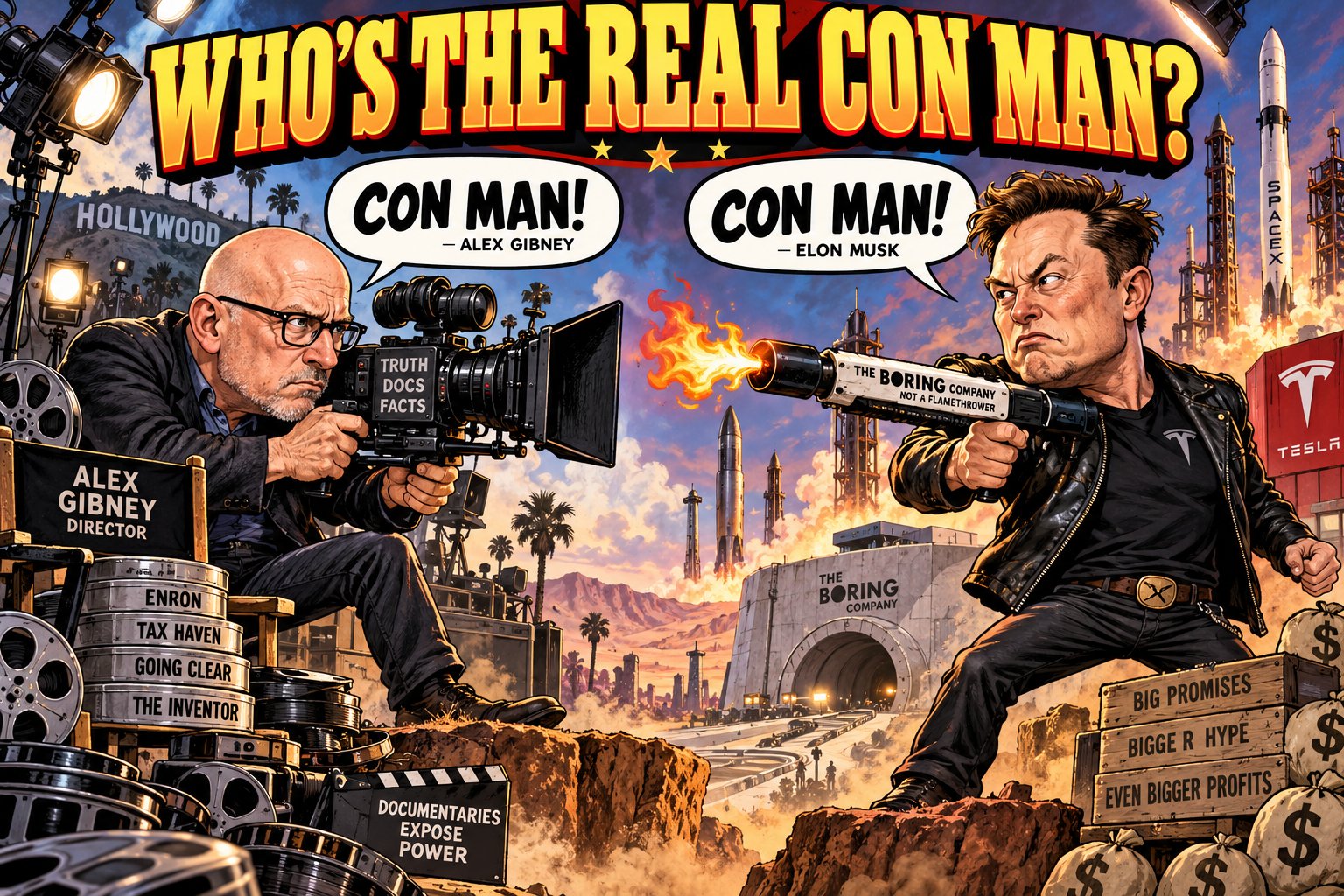
What if Elon Musk PAID Alex Gibney to make the "Musk" documentary?
Apologies in advance. This is an attempt to review a documentary I didn't get a chance to see, and also to organize scattered thoughts, theories, and impressions into what will be an unpopular defense of Elon Musk. I say he is doing more good than harm. I say Musk is a master marketer and showman who does and says weird and stupid things — and sometimes cool things, like those SpaceX launches as seen from Malibu — because that's his form of PR and advertising. I say he is advancing the green revolution toward renewable energy and electric cars, and the foundation and push he is laying down will continue to resonate in positive ways — like saving the world from global economic collapse and chaos — long after Donald Trump is gone and buried on a golf course somewhere. This is scattered because this is all complicated.
A four-hour tour
Aw crud, it's a fine, clear, blue, fall, post-rain Saturday in Santa Cruz, and I was girding myself and clearing storage space on my smartphone to sit through and surreptitiously record (audio only) Alex Gibney's four-hour "Musk" documentary.
I was going in with opinions and biases — mostly negative, toward the filmmaker — bubbling in my Gulliver, but I was going to record all the talk, transcribe it with Otter.AI and then run the transcript through Claude.AI to write a review that I was pretty sure was going to be negative — about Gibney.
Why negative? I saw some pre-release interviews with Gibney where he declared Musk a "con man," and all the words from him — and from social media — were accentuating the negative about Elon Musk: spending hundreds of millions to get Donald Trump elected, accusations of election fraud, costing a lot of people their jobs with DOGE, and being responsible for the deaths of hundreds of thousands to millions of fellow humans in troubled countries by abruptly ending USAID.
The Guardian called Musk "the world's richest and dullest man," an "ersatz visionary and Trump courtier" — and that was the nice part.
Love the movie, hate the man
The critics who sat through "Musk" agree on two things: they love "Musk" the movie, and they loathe Musk the man
The Guardian's Peter Bradshaw calls Gibney's film excellent and absorbing, then headlines his review an "epic study of the world's richest and most banal man." He paints Musk as a brattish plutocrat and Trump courtier, a modern Augustus Melmotte, Trollope's charlatan financier.
Variety's Owen Gleiberman calls the film definitive, lacerating and important, a showcase of Gibney's mastery of the form. Then he calls Musk a messianic opportunist and something of a crackpot, "a creator of mirages who promises more than he delivers."
Writing for RogerEbert.com, Nell Minow goes further, saying the film "may be the most important film of the year," and that Musk is better at engineering everything around him to serve his ego and his bank account than at engineering his products.
Raves for the movie. No stars for the man.
And yet, buried in the takedowns, the critics concede what Musk built. Bradshaw admits Musk is no Elizabeth Holmes or Sam Bankman-Fried, because Tesla is a long-running, profitable company and SpaceX invented reusable rockets.
Gleiberman admits that the Tesla is a strong and beautiful car, and that Musk's early push for electric cars was a positive force in the world.
Even the harshest of the three lets a NASA official say SpaceX saved the agency millions.
The yin of Elon Musk
It is easy to criticize Musk for spending hundreds of millions to support Trump, for taking a flamethrower to American bureaucracy with DOGE, and for pulling the football away from millions of impoverished, sick, and starving humans.
But do the critics point out all the good he is doing? The success of Tesla has kickstarted the green revolution more than any other event, and Musk is moving the world toward an inevitable and vital future: electric vehicles running on renewable energy.
Musk has created well over 100,000 jobs with Tesla and SpaceX and Neuralink and the Boring Company and his other projects, and many more at suppliers, and there are people reading this column right now from lanais and yachts and by swimming pools paid for with the capital gains from the more than a trillion dollars in new wealth Musk has created with his companies — and will continue to create.
Tesla built its 10 millionth electric car this summer, the first automaker in history to get there. Not bad for a banal man.
Is Musk banal?
What does that word mean exactly? "Banal means so ordinary, predictable, or overused that it's dull and boring: lacking originality or freshness."
Well, no, Musk isn't that. He has a high-end, sophisto sense of humor you may need to be a sophisto to understand.
When Musk was criticized in September 2022 for refusing to switch on Starlink coverage for a Ukrainian drone attack on the Russian fleet at Sevastopol, he explained himself, essentially, that Starlink was meant for watching Netflix and chill, not for drone strikes.
That's a funny guy.
Brattish, maybe. But banal? A banal man doesn't launch his own cherry-red Roadster into orbit around the sun, with a spacesuited mannequin at the wheel, Bowie on the stereo and "DON'T PANIC" glowing on the dashboard.
He doesn't name his rocket-landing barges after starships in Iain M. Banks novels, "Of Course I Still Love You" and "Just Read the Instructions," or sell 20,000 "Not-a-Flamethrowers" at $500 a pop.
He doesn't stroll into Twitter headquarters carrying a sink so he can say "let that sink in."
A banal man doesn't quote "Spaceballs" by giving his cars a Ludicrous Mode, a Plaid mode and a fart button.
A banal man doesn't take a dreary federal rule requiring electric cars to make noise below 18.6 mph, so pedestrians can hear them coming, and turn it into a punchline: a "Patsy Mode" that lets your Tesla clip-clop out of a parking spot to the sound of coconuts, like King Arthur's horse in "Monty Python and the Holy Grail."
He doesn't name his cars so the lineup spells S3XY. A banal man doesn't tweet a weed joke about taking Tesla private at $420 a share and pay the SEC $20 million for the punchline, or watch his "unbreakable" Cybertruck window shatter on stage, twice, and take the orders anyway.
Banality doesn't name a baby X Æ A-12, host "Saturday Night Live," or challenge Mark Zuckerberg to a cage fight.
Dorky, nerdy, juvenile, arrogant, defensive, disregarding, sometimes.
Banal? Not on your life!
Con artist or visionary?
"Is he a con man? Yeah, he's a confidence man. He's not Elizabeth Holmes, in the sense that he didn't have a device that was useless. He's a con man in the sense that he creates bigger and bigger fictions every step along the way, because he's always got a problem at his companies, which is how to raise more money."
— Alex Gibney, on The Moynihan Report
After two short weeks in Santa Cruz, "Musk" has been displaced by "You Can See Everything." Speaking of con artists, Elizabeth Holmes really is one. A con artist, as Claude defines it, is "a swindler who cheats people by first gaining their trust, then exploiting it for money or advantage." The con is short for confidence: the trick is persuading the mark to hand something over willingly.
Holmes is a tried and convicted con artist, con woman, whatever. She promised things she knew she couldn't deliver. She was sentenced in November 2022 to 11 years and 3 months for defrauding Theranos investors, and reported to a Texas prison camp in May 2023, so she's about three and a half years in. Thanks to good-behavior credits, she moves to an Austin halfway house in August 2027 and walks free in February 2030, more than four years early. And she's asked Trump to commute what's left.
Conning a con man? She might not be alone.
Musk promises a lot and doesn't always deliver on time — no wine before it's time — but when he delivers, he delivers miracles of modern science — impossibilities "they" said could not be done: electric cars, the CYBRTRCK, private space business, reusable rockets that land on platforms halfway down Baja.
And that bitchin rocket car, released the same weekend the Musk documentary hit screens.
When people look at Musk they see money, but there is a lot more to it than money. Being right about things is a different satisfaction, and maybe a deeper one.
Musk made about $180 million from the sale of PayPal, and if he was only about money he could have bought an island and kicked it in the Caribbean surrounded by supermodels and watched the world fall further into chaos.
But what did he do? Went all in, with almost all of it, on two projects "they" said couldn't be done: making an acceptable electric car, and privatizing the space business.
Musk loves doing things that everyone else says cannot be done, or should not be done: from supporting Trump to going to Mars.
What if Musk paid Gibney?
So I had a lot to say about Musk and wanted to say it in the form of a review of the "Musk" documentary, but I waited too long. It was here and gone in Santa Cruz. No longer playing anywhere close, so I'm gonna have to wing it, around this theory: Elon Musk is a clever bastard who knows there is no such thing as bad publicity, so what if Musk PAID the Oscar-winning documentarian to make a four-hour anti-Musk documentary that would expose all his dirty laundry and put the Musk name on everyone's lips?
Ludicrous? Maybe not.
Musk knows he's not evil, he knows he's doing good things, and he plays the looooooonnnnnng game. Like saving the world's ass from collapse?
Musk's PR strategy is the far-out, 21st-century extension of "There's no such thing as bad publicity." As long as people are talking and arguing about him, good or bad, and the words Musk, Tesla, and SpaceX are on everyone's lips, he's doing his job.
He doesn't waste much money on advertising, for Tesla anyway. Starlink advertises. Musk gets good value and free advertising by doing and saying stupid shit to attract attention, and gets publicity no amount of money could buy.
Musk did not sit for an interview, so Gibney's team built a computer-generated Musk that speaks directly to the camera. Gibney had to make a fake Musk because the real one wouldn't show up — a digital stunt double to take the punches. And the punches keep coming: the film runs 235 minutes, nearly four hours, and a longer cut is due on HBO in 2027.
That's another year of everyone saying "Musk."
So maybe Musk PAID Gibney to air all his dirty laundry, to interview hostile witnesses like Eberhard, an ex-wife, an ex-girlfriend, dear old dad, and other hostiles, and put it out there for the world to see, argue over, hit from all sides, and come to its own conclusions.
Edison, Ford, Hughes, Wonka, Jobs, Stark.,
Musk is a weirdo, but that's expected of him and all the abnormally driven, world-changing, visionary cuckoos: Edison, Ford, Hughes, Wonka, Jobs, Doc Brown, Gates, Stark.
It's weird to be that driven and that smart and that successful. And it makes you a weirdo. No matter what Musk does, he's gonna be classified as a weirdo, so he does weird things, says weird things.
Musk seems to enjoy doing what everyone tells him can't be done, or he shouldn't do. And that includes alienating the liberal leftists who supported him, and throwing around hundreds of millions to get Trump elected.
Say what? Have you seen the bumper stickers on Teslas: "I bought this car before I knew Elon was crazy."
Crazy like a fox, maybe.
It's a complicated world
Did Musk try to shut the movie down? In recent weeks, Musk has called Gibney an "idiot," a "horrible human," and a "tinfoil hat crackpot" on X. AP reports the film faces more than a war of words, with Musk's lawyers using the CGI Musk to discredit it. But the film opened anyway. Name-calling from the world's richest man, on the platform he owns, is the best trailer money can't buy.
Okay, here's what happened: "Musk" in Hollywood-speak “didn't open,” nor did it “find an audience.” There are plenty of people out there bumming about Musk, but apparently not enough to sit for four hours of harsh negativities.
Gibney spent nearly four years making "Musk" — one year per hour — with an AI avatar and the kind of legal vetting you need when the world's richest man is threatening to sue. There's no official budget, but one estimate puts it at $10 million to $15 million. Bleecker Street opened it in four theaters on Oct. 9, widened it to 472 screens on Oct. 16, and by the next weekend it had vanished from nearly all of them, with screenings canceled and a few lonely morning shows hanging on at places like the Angelika in SoHo.
The take: a $290,000 opening weekend nationwide, about $614 a screen, 20th place at the box office, and under $600,000 total.
Why so fast? Take your pick. Four hours is a long time to sit in the dark with anybody. Bleecker Street says it struggled to buy ads on X, which Musk owns, and TikTok suspended its ad account on opening weekend, then called it an "error."
Bleecker Street announced its own sale the day before the film went wide. And HBO, which owns the streaming rights and plans to show an even longer cut in early 2027, is being swallowed by Paramount, run by David Ellison, whose family is close to Musk.
Gibney says he has serious doubts HBO will ever air it. Musk has called the film boring, a hit piece, and Gibney a man of zero integrity, all before most people could see it.
Bad publicity? There's no such thing.
So who used who? The real winner here? Not Gibney.
Did Musk use Gibney? Is he using Donald Trump?
I have suspicions: Musk is playing the long game. He is doing more good than harm, and what he is laying down now — foaming the runway for a non-apocalyptic renewable EV future, and bringing infallible satellite internet connectivity to every village from Alaska to Zimbabwe — are good things that are going to resonate long after Donald Trump is gone and buried on some golf course somewhere.
Everyone focuses and freaks out about Musk's money, but it's just a tool for progress, a tool for change, and Musk needs oceans of it to head off the potential apocalypse, launch satellites, get to Mars.
Every time he blows up a Starship, it’s a hundred million bucks.
Musk wants to go to Mars for the same reason Magellan tried to circumnavigate the globe, Amelia Earhart tried the same, Mallory and Hillary eyed Everest, and Lewis and Clark explored the Louisiana Purchase: because it's there, it's a massive engineering challenge and a grand adventure, and how many of those are left?
Tesla and SpaceX are shaking up the world now. Neuralink could be next: it's already letting paralyzed patients move a cursor with their thoughts, and Musk's endgame is merging the human brain with artificial intelligence.
Musk is doing more good than harm, but you have to see the Big Picture, the Long Game.
Sometimes to do good you have to engage in evil.
Will these seemingly nasty ends justify the means?
To quote a weird Escher-esque Van Halen line: “Only time will tell if we stand the test of time.”
There’s a lot more to say about Gibney and Musk and the world in general. Next week, Part Two: Is Musk using Trump, or is Trump using Musk? Is Gibney the actual con man here? Mars, Starlink, DOGE — and what happens when the juice runs dry.