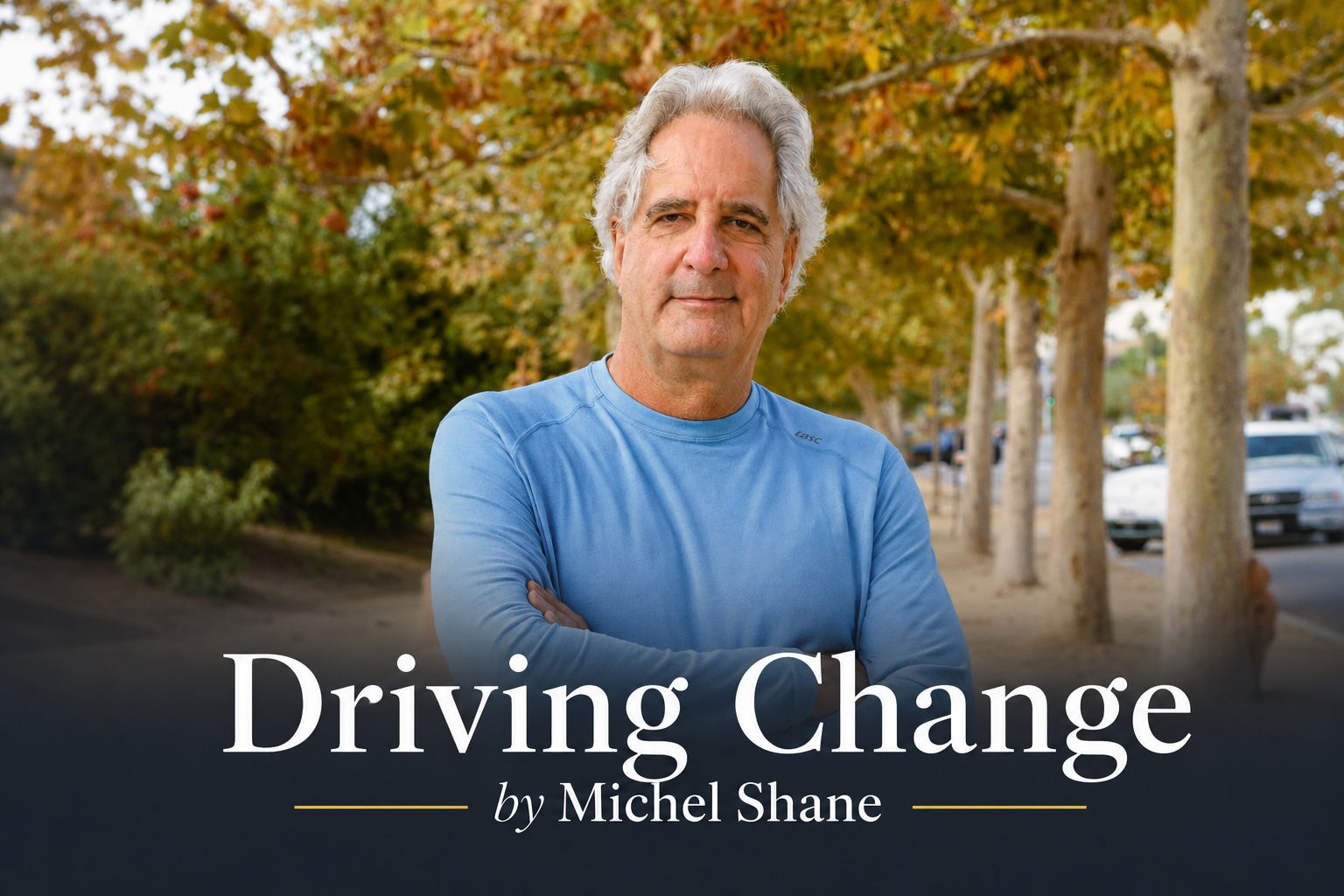
Driving Change: What the cameras didn't count. Malibu counted the dead. I counted the promises.
By Michel Shane · Fri Oct 16 2026
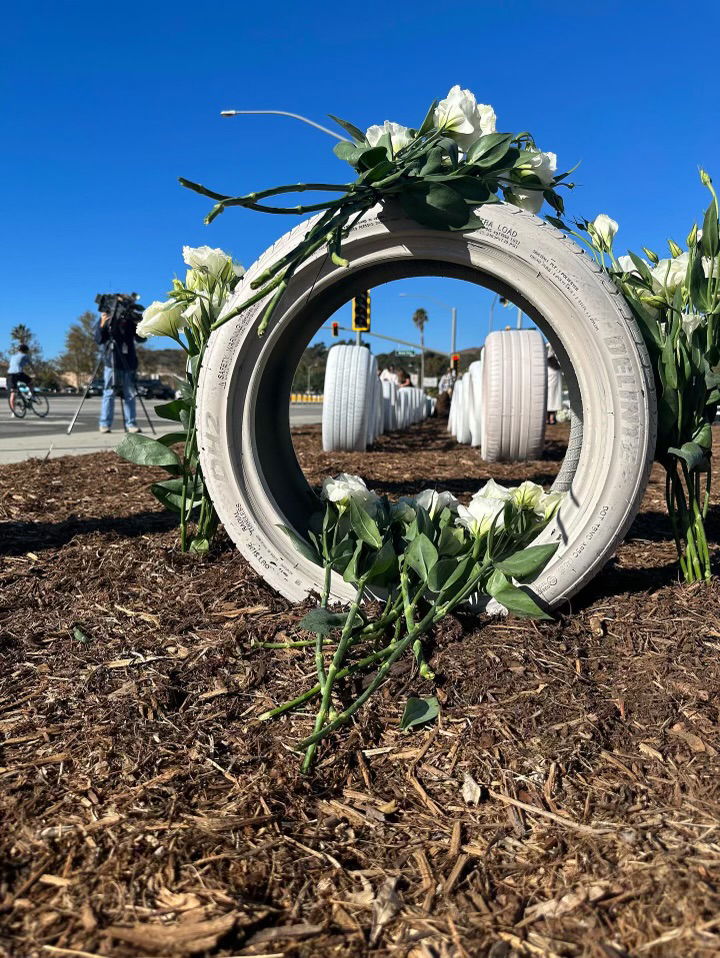
In the weeks after the crash, volunteers from Fix PCH laid four white tires beside Pacific Coast Highway near Webb Way, one for each Pepperdine student killed. On Sunday, Nov. 19, 2023, we laid 58, one for every person killed on PCH in Malibu since 2010. The count today is 64. The four were Niamh Rolston, Peyton Stewart, Asha Weir, and Deslyn Williams. On Nov. 14, 2023, the people who run this road sat at one table in Malibu City Hall and told us what they would do. I was in the room.
Some of what that room promised got done. Others and I fought for some of it. The California Highway Patrol returned to PCH in January 2024 for the first time since Malibu became a city, and the council renewed the contract. The Legislature passed a speed camera law for Malibu. Barry Stewart, Peyton's father, testified for it in Sacramento. I did as well. Caltrans spent $4.2 million on lane separators, striping, speed bars, and feedback signs, and that work is on the road today. The 12 signals between Topanga Canyon and John Tyler finally run in sync. The city says injury collisions are down 22 percent since October 2023.
Then look at the count. Between that meeting and the end of 2024, four more people died on PCH in Malibu, three of them after the CHP came back. That is about as many as the road killed every year before. Nobody died in 2025, the year the Palisades Fire closed or restricted the highway for months. A road without traffic kills no one, and the same closures cloud the 22 percent. This year the traffic came back, and so did the count.
On Oct. 3, a 16-year-old driving a Range Rover crossed the fog line in the 22600 block, just west of where the 25 mph zone starts, and hit a parked car. Ryo Uchimiya, 51, was inside. He died there.
The gains never touched the speed limit. In that room, Caltrans said its goal was a lower limit. Asked whether it could happen, Caltrans said it was "hard to say." Five weeks later, on Dec. 19, 2023, it said its data "would not lead to a reduction at this point in time." The reason has a name. Under the 85th percentile rule, Caltrans starts from the speed that85 percent of drivers stay at or under and sets the limit near it. The faster we drive, the more the law agrees with us.
Nearly three years later, the only lower limit on PCH came from a fire. The 25 mph signs on the eastern end went up for repair crews. Rebuilding the road and the homes lost in the Palisades Fire could take up to 10 years. When the crews leave, nothing in the law keeps the limit low.
Barry Stewart said in that room that he would judge the agencies on results. I asked him this month how he judges them now. "The cameras are a welcome baby step toward a safer PCH Malibu," he wrote. Then he did the math on the limit: "If hypothetically it were reduced to 35 MPH on the mile of PCH that has killed and injured the most people, that would have the effect of lengthening a speed-limit driver's trip through that mile by a whopping 23 seconds."
Twenty-three seconds.
That is what Barry's math asks of a driver on the worst mile of this road. No agency has asked it.
David Rolston, Niamh's father, told that room about Philadelphia. That same fall, the city's Vision Zero report found that speed cameras on Roosevelt Boulevard had cut fatal crashes in half. Road diets on its most dangerous streets had cut injury crashes by 18 percent. Its 20 mph neighborhood slow zones had 75 percent fewer crashes, and no fatal or serious-injury crashes. Philadelphia changed its streets while we held meetings about ours.
Here is what is different now. The city declared PCH an emergency in November 2023 and has renewed it every 60 days since. For three years, that emergency has had no deadline. Now it has several. The speed survey for the eastern end comes back in November. The cameras start mailing warnings the same month. The first fines, and the first camera money, could come in January. Malibu has not had a moment like this since that meeting in City Hall.
Two decisions will determine what happens next.
The first belongs to the state. The 85th percentile is where Caltrans starts, and since 2021 the law has let it go lower. It can round the limit down. It can give more weight to people on foot. On a highway designated a safety corridor, it can take off5 more miles an hour. That designation was the city's top request in that room. Three years later, PCH still does not have it, and we keep adding tires.
Today the speed limit follows how fast drivers already go, and too many fixes wait for the crashes to pile up first. Why is death the measure of safety? Nobody needs another funeral to learn where PCH kills. The cameras can now measure speed on PCH every hour of every day, and nobody has to be buried to get the number.
The old argument against a lower limit is that drivers will ignore it and police cannot write enough tickets to change their minds. Cameras answer part of that. A camera doesn't get tired or look away. But five cameras cover five spots on 21 miles. Drivers brake for the camera and speed up once they pass it. A limit only holds on the miles between the cameras when the road itself slows people down.
If Caltrans will not use the authority it already has, the Legislature should take the decision out of its hands. Sacramento wrote speed cameras into law for Malibu in ten months. It can write PCH out of the 85th percentile rule just as fast. A government that waits for the next death to confirm what it already knows has made the next victim the price of proof.
The City Council makes the second decision. Under SB 1297, whatever the cameras collect after the program and the patrols are paid goes to traffic calming on PCH in Malibu. If it is not planned or built within three years, it goes to a state program. The city and Caltrans are still working out the agreement that will govern that money.
This February, a man was killed crossing PCH at Winding Way at night. The crossing was dark. Caltrans never planned a light there, and its criteria-count past crashes before a spot earns one. The city does not have to wait for that count. On Monday, I asked the council to put a ranked list of projects on its agenda before Dec. 31, with Caltrans review dates attached and Dark Sky-compliant lighting at the top. I also asked it to report publicly every year where each dollar stands. Money with a deadline needs a plan with dates.
When that list comes before the council, come to the meeting and say what you want built. If you cannot be there, write to the council. None of us knows whose life will be the next one counted.
Four tires first. Fifty-eight that Sunday. Sixty-four now. The next number is ours to decide.