City council seeks traffic signal study for crossing near Malibu Seafood
By Hayley Mattson · Fri Oct 16 2026
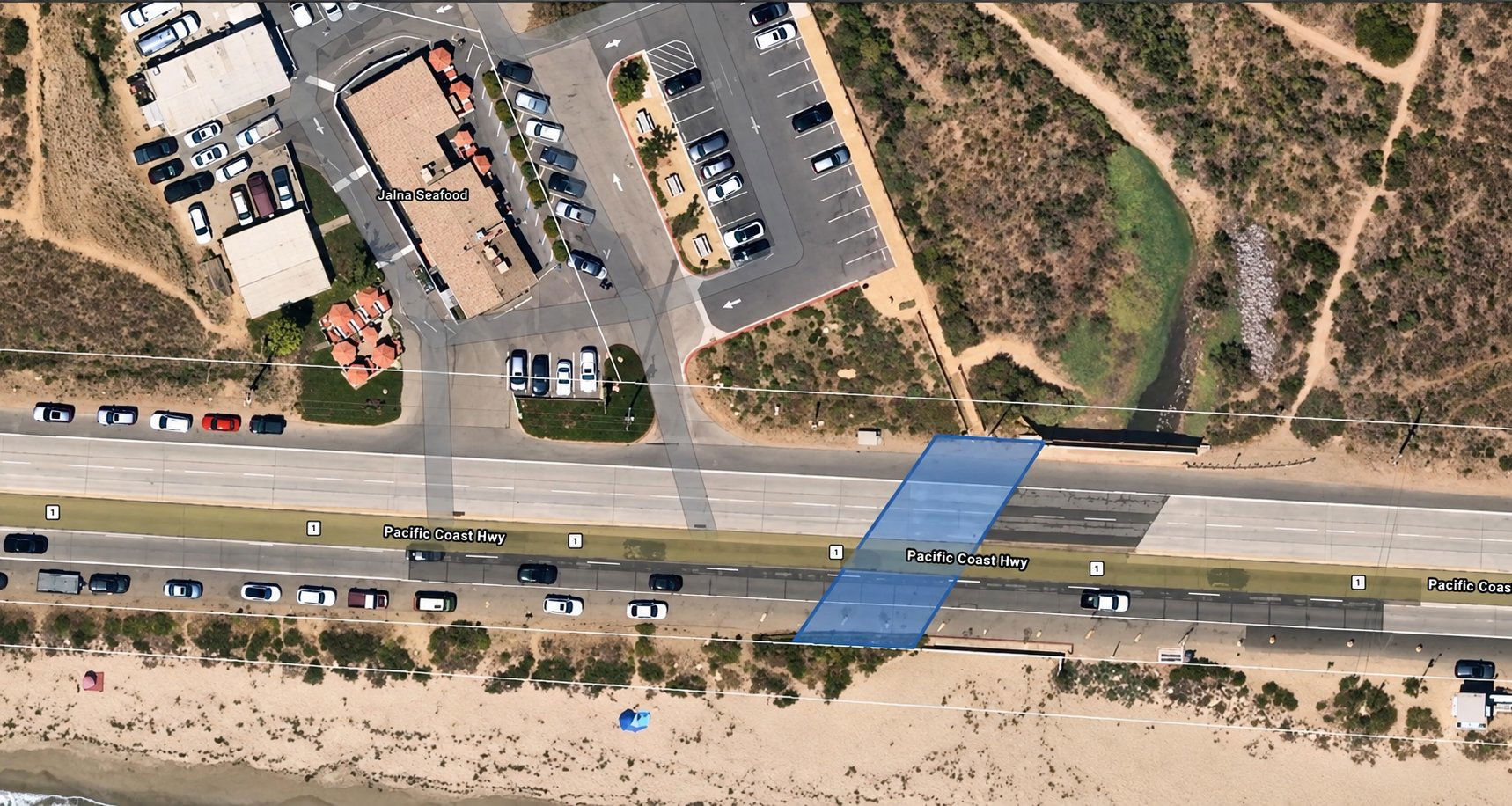
After years of discussion, council directs staff to seek Metro approval to study a street-level PCH crossing with advance warning signals and a possible median barrier
A long-discussed effort to provide safer pedestrian access across Pacific Coast Highway near Malibu Seafood took a new direction Monday, as the City Council asked staff to pursue a study of a street-level crossing with a conventional traffic signal rather than move forward with the proposed under crossing study. At the Oct. 12 meeting, council members raised concerns about the cost, flooding risks and construction challenges of building a pedestrian tunnel near the beach. But they also emphasized that leaving people to navigate the busy highway without a nearby marked crossing remains a safety problem.
The council approved a motion without opposition directing staff to return to Los Angeles County Metro to request permission to use project funding for a study of a signalized, street-level pedestrian crossing, potentially including advance signal warnings and a center median barrier.
The action does not authorize construction or establish a final crossing location. Metro must first determine whether the proposed study fits the funding agreement or requires changes.
For residents and visitors traveling between Malibu Seafood, the nearby trailhead and the beach, the discussion addressed a familiar dilemma: how to cross a stretch of PCH where the posted speed limit is 50 mph and the nearest marked crossing is more than half a mile away.
According to staff, there are only three marked crossings along roughly three miles of highway between Latigo Canyon Road and Malibu Canyon Road. The closest to the proposed project is at Corral Canyon Road.
That distance contributes to informal crossings throughout the area, with pedestrians moving between parked cars, the restaurant, hiking access and the shoreline.
Council members described seeing families with small children, people waiting in the median and drivers stopping unexpectedly to allow pedestrians through. Several stressed that the project serves beachgoers and hikers as well as restaurant customers.
The effort dates back more than a decade. Staff said the 2015 PCH Safety Study recommended a pedestrian under crossing at the location to improve beach access.
In 2019, Caltrans proposed a pedestrian hybrid beacon, also known as a HAWK signal. The system remains dark until activated by a pedestrian, then signals vehicles to stop so people can cross.
Following public meetings in March and October of that year, community members, commissioners and elected officials supported investigating an undercrossing instead. Staff said Caltrans terminated the beacon project in 2022 following concerns from the city’s Public Works and Public Safety commissions.
The undercrossing proposal returned to a joint meeting of those commissions on Aug. 26. Commissioners recommended moving forward with a cooperative agreement with Caltrans for the project initiation document phase, while maintaining a preference for an undercrossing and expressing interest in an overpass. They also raised concerns about creek levels and flooding.
On Monday, staff requested authorization for a $260,000 agreement with Caltrans to provide quality assurance and oversight during that initial planning phase. Staff also sought an amendment extending the availability of certain Metro Measure M funds through June 30, 2027.
The project has $2.25 million in Measure M funding. Staff said the proposed planning phase would take approximately 10 to 12 months and would refine alternatives, costs, schedules and the project’s scope.
The preliminary comparison presented three construction options: a street-level traffic or HAWK signal estimated at $2.36 million; a new roadway bridge incorporating a pedestrian undercrossing estimated at $22.8 million; and a standalone pedestrian tunnel estimated at $10.9 million.
Those estimates remain preliminary. The cost of the conventional traffic signal configuration discussed by the council has not been finalized.
The street-level option received the highest overall score in the initial evaluation, earning 90 out of 100 points compared with 73 for the bridge alternative and 81 for the standalone tunnel. The evaluation considered safety, connectivity, accessibility, environmental impacts, cost and construction feasibility.
Both undercrossing alternatives scored higher for safety because they would separate pedestrians from highway traffic. The street-level option scored better overall because of its accessibility, lower cost and fewer construction and environmental challenges.
Public commenters offered differing views on how to proceed. Two urged the city to defer the project, questioning its financial implications and arguing that the state should bear responsibility for improvements to PCH.
Another speaker supported a safer crossing but asked the city to explicitly investigate whether the existing Corral Creek bridge and drainage infrastructure could be modified before building a separate structure. The speaker also urged engineers to examine groundwater, tidal influence, flooding, sediment and long-term maintenance.
Those concerns carried into the council’s discussion. Members questioned whether an undercrossing could remain usable in a coastal setting, citing sand accumulation and flooding problems at other local underpasses.
Several favored a conventional traffic signal over a pedestrian-activated HAWK system, saying a familiar red-yellow-green light could give drivers clearer expectations. Members also discussed barriers to guide pedestrians toward the designated crossing rather than allowing crossings to remain dispersed along the highway.
Safety concerns extended to the highway’s slope and curve, visibility for approaching drivers, and vehicles entering and leaving Malibu Seafood. Council members requested consideration of flashing advance warnings to alert motorists approaching the signal.
They also raised concerns about vehicles parked between the restaurant’s driveways obstructing sightlines and encouraged consultation with Malibu Seafood as the project develops.
Staff explained that the existing Metro funding agreement identifies an undercrossing, meaning a narrower study focused on a conventional traffic signal would require coordination with Metro.
The council ultimately chose that step, seeking clarity on the use of the funding before committing to the broader planning effort.
For now, the crossing remains unresolved. Monday’s vote establishes the council’s preferred direction for further study, while leaving the signal’s feasibility, location and safety measures to be evaluated before a construction decision.